The SREC (Solar Renewable Energy Credit) customer support team at Sol Systems provides in-house services and assistance to more than 18,500 customers and partners. Our Service Spotlight Series gives our clients the chance to learn more about the individuals that support their SREC solutions. Today we chatted with our Customer Service Analyst, Lucas Ludgate.
Lucas Ludgate is an SREC Customer Operations Analyst on the SREC team.
1. What brought you to Sol Systems?
I knew a couple of people that were working with Sol, and they all spoke very highly of the company. During my interview, everyone that I talked to was extremely passionate and loved the work they were doing. I started in February of this year, and I’ve been really enjoying it.
2. What motivated you to pursue a career in renewable energy?
In college, I majored in Environmental Studies, and I always knew that I wanted to pursue a career in the renewables industry. I wanted to find meaning in my work and be able to create impact. Whether you’re building a solar array or assisting in the payments for solar renewable energy credits, the people at Sol can see the positive attributes of their work.
3. Why do you like working with SRECs specifically?
They’re a great incentive to get people to go solar. Personally, I love to help people and solve problems and my work combines those to make sure people are getting incentives for their decision to switch to renewable energy.
4. What’s your favorite part of working on a customer service team?
I love it when there is a tricky situation and either myself or my team can turn it around, resolve the issue, and make the customer happy. It’s also nice knowing that the work that I do helps our clients regain faith in the company.
5. Outside of Sol Systems, what do you like to do for fun?
I love to golf. I played golf in college and enjoy getting out on the course with friends. I also love to cook, specifically Italian food. I went to Italy for my honeymoon, and it’s something my wife and I love to do together.
Battery Storage is the Way of the Future: Have You Accounted for the Right OpEx in Your Financial Model?
Technology |
By The Sol Systems Team
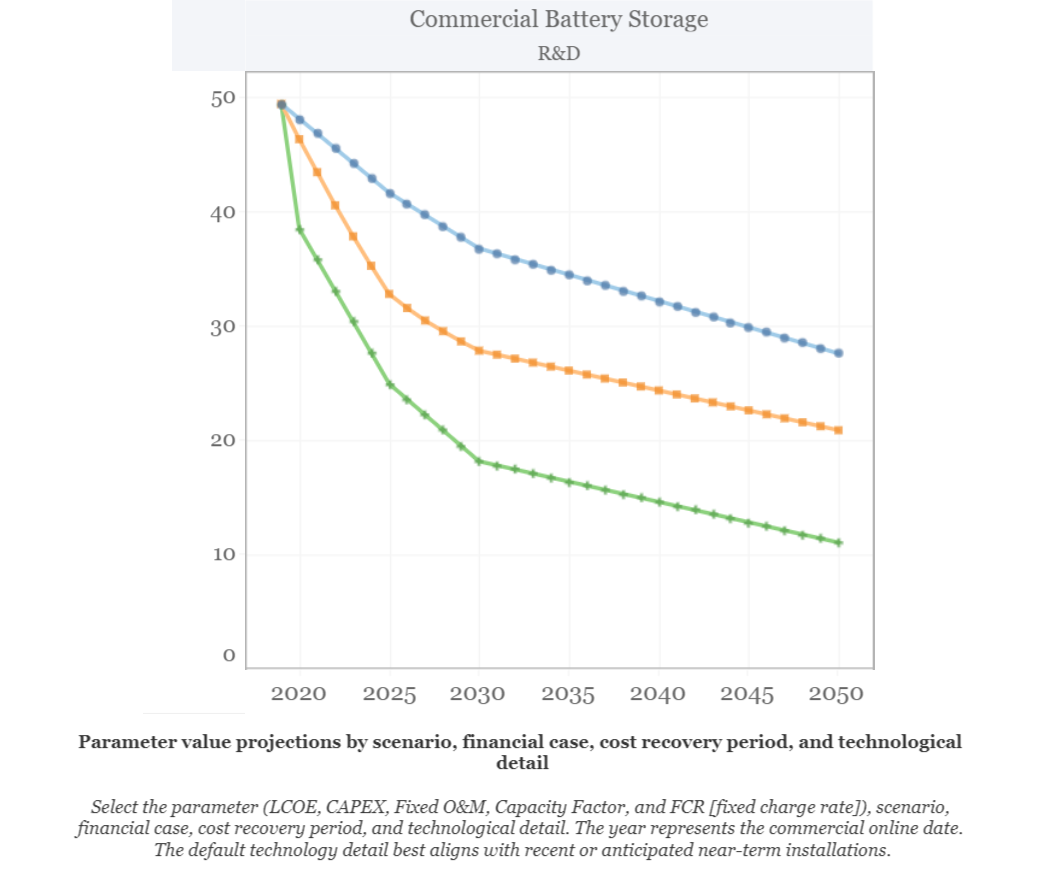
Most solar developers around the world are rushing to add lithium-ion battery storage to as many projects as possible and to update financial models to account for the added development and OpEx challenges they present. Without many operating batteries on the market, many developers and owner-operators (Sol included) are continuing to update their OpEx assumptions. Public reports, such as this 2020 NREL forecast for commercial-scale battery storage, provide forecasts for how fixed O&M costs will decline over time, but these projections are difficult for developers to integrate into project economic models without more operational data. Even the few public reports published in 2020 and 2021 include not only a range of published O&M costs—see the table below for a few examples—but also report significant uncertainty onthe scope of those examples.
While battery original equipment manufacturers (OEMs) and integrators can advise developers on what some of these costs might be, such as preventative maintenance or a Long-Term Services Agreement (“LTSA”) that includes an augmentation plan, many of these project costs are up to the developer to assess and to integrate into economic models. Battery energy storage systems (“BESS”) present a huge opportunity for the clean energy industry as deployment grows and hardware costs decline.
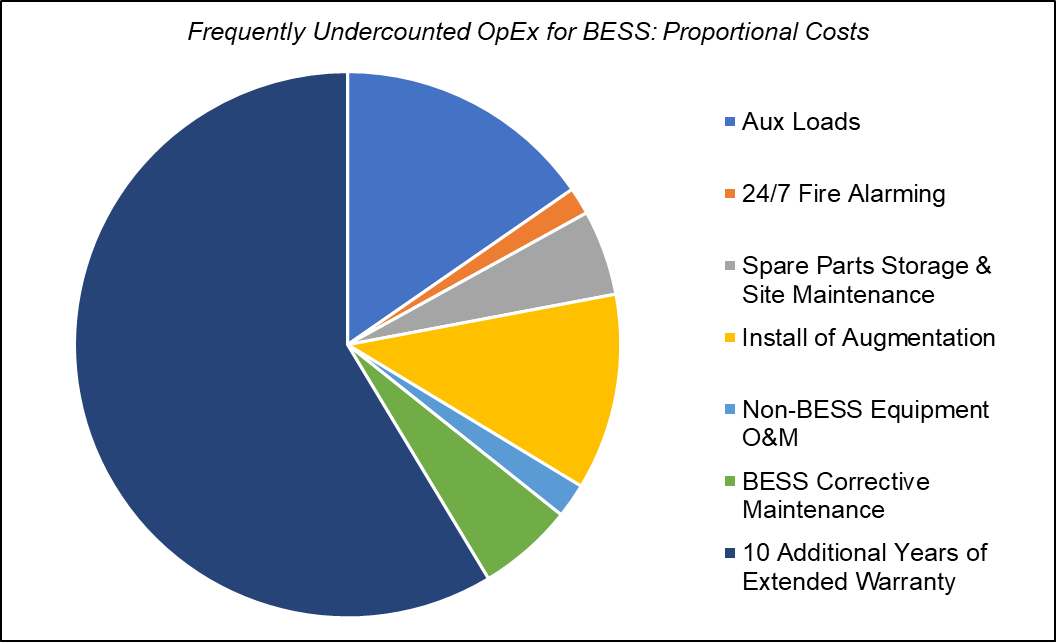
1. Auxiliary Loads: For technical and economic reasons, most often the thermal management systems and SCADA are served by a separate feeder, using retail power from the grid rather than the solar system. Auxiliary load profiles are hard to estimate and vary from project to project depending on precise cycling patterns and the applicable BESS product. Battery OEMs and integrators may not be able to provide these estimates early on, leaving developers struggling to include reasonable estimates in their models. Even Tesla Megapacks, known for their ability to use the battery’s own charge to power its thermal management system, still require some additional auxiliary loads (e.g., additional SCADA for the entire BESS). For most utility-scale battery systems, these additional auxiliary loads are separately served by their own retail meters.
2. 24/7 Emergency Alarming with the Fire Department: Many BESS integrators offer a basic preventative maintenance package that includes valuable alarming and forecasting of specific equipment deficiencies that could eventually lead to fires. The responsibility of contacting the fire department in the event of an emergency fire alarm, however, is still often passed around like a hot potato. For smaller developers without a 24/7 network operations center, this all-hours fire alarm notification requirement is something that they must be ready to cover themselves.
3. Climate-Controlled Spare Parts: Capacity Maintenance Agreements (CMA)[1] typically require the asset owner to purchase a specific list of spare parts. Make sure to ask for this list and associated costs in advance—because they can add up! However, some (e.g., the battery modules) require specific climate conditions and appropriate documentation of said conditions to maintain any applicable warranties. Luckily, they are the same as the operating modules require, so the simplest solution is to leave several empty racks and simply store the spare modules in the same enclosure as the operating battery (with a battery management system (BMS) to track conditions).
4. Install of Augmentation: The installation of the augmented BESS modules is often a forgotten scope item and uncounted cost in the initial pre-Notice to Proceed (“NTP”) financial model. Most BESS integrators are not prime construction/engineering contracting firms and treat the install and balance-of-system of the augmented BESS modules the same way as they do the initially installed modules, assuming that the developer or asset owner is responsible for install. Ensure that you don’t undercount the future cost of mobilization and lifting equipment rental. While this gives developers the flexibility to shop around for price, it leaves some uncertainty on the table as to what the cost of installing additional BESS units will be in 7–15 years. There are ways to construct the initial build with everything in place to make that mid-term augmentation as efficient to install as possible, but we are all making calculated assumptions about what the future install cost will be.
5. Non-BESS Equipment O&M: BESS integrators provide the BESS modules/enclosures, the inverters (PCS), and often the medium-voltage transformers. Beyond that, your EPC partner or in-house construction team will be procuring a much longer list of equipment, and the maintenance of this additional equipment is often a forgotten cost as well. If a BESS is paired with a solar project, the O&M provider for the solar project can typically offer this O&M for a reasonable additional cost. Alternatively, if the BESS is standalone, this additional O&M is both more expensive and can be harder to find—therefore, it is even more important to add these costs into the model early on.
6. Corrective Maintenance for Smaller BESS: For smaller BESS where a CMA doesn’t make sense economically, integrators and BESS vendors provide a wide range of contract-term services, and it can be hard to parse through different defined terms from different vendors and evaluate if they are covering equivalent scope. Most offer preventative maintenance that is explicitly mentioned in the BESS proposals, but the corrective maintenance is frequently left out of many offerings for smaller projects (or the costs are ‘TBD’ depending on the future number of corrective maintenance events) and can easily be left out of an early-stage financial model if the developer isn’t careful.
7. Extended Warranty: In addition to corrective maintenance, another sometimes-hidden cost is the warranty extension (which is typically named different ways by different OEMs). Different vendors include different warranty lengths with the system purchase, but there is typically a cost to extend beyond 15 years and often a cost to extend beyond even just 3–5 years. Failing to purchase this extended warranty for the full term of contracted revenue would leave an unthinkable scope gap that financiers won’t accept, and therefore, these warranty extensions are a need-to-have.
As the industry grows and matures, the standard OpEx assumptions for BESS projects will be easier to forecast and calculate. We are looking to add energy storage for all of our utility-scale and distributed-generation solar projects, and we are working with several customers on standalone battery opportunities. What is clear is that energy storage will continue to be a key aspect of project development and energy management going forward, and the Sol team is eager to work with our development partners and customers to create as many new opportunities as we can.
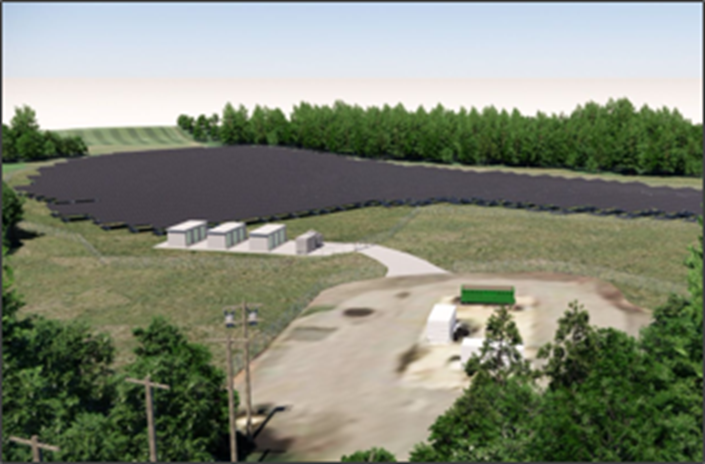
Sol’s 5 MWh BESS + solar rendering in Holliston, MA for the Town of Holliston – Under development
[1] A Capacity Maintenance Agreement (CMA) is a commitment by a BESS integrator to maintain a certain capacity from beginning-of-life commissioning through a full contract term (e.g., 20 years) using a combination of oversizing and augmentation.
The SREC (Solar Renewable Energy Credit) customer support team at Sol Systems provides in-house services and assistance to more than 18,000 customers and partners. Our Service Spotlight Series gives our clients the chance to learn more about the individuals that support their SREC payments. Today we chatted with our SREC Customer Support Manager, Aina Lusis.
Aina Lusis is a SREC Customer Support Manager on the customer support team.
1. What brought you to Sol Systems?
I came to Sol because I wanted a change of pace and environment. There is a nice balance between work environment and work ethics at Sol Systems. Sol’s great culture stems from open communication with a work hard, play hard mentality. This fosters an incredibly supportive environment with open dialogue and cross team collaboration at the forefront.
2. How have your previous roles prepared you to transition to your current role on the customer service team?
My psychology degree gave me a boarder understanding of how people think, emphasize, and communicate. After college, I put my focus into politics and campaign work, which required me to talk to different constituents about various subject matters, giving me a solid understanding of the person behind the screen as well as the information at hand. In my previous job, I used my background to create positive experiences for customers through communication practice, relationship building, and personability.
3. What motivated you to pursue a career in renewable energy?
I have always been passionate about environmental issues, and when I found Sol, I knew that this opportunity came at the right time. From there, everything fell into place.
4. What processes are you looking to build from at your current position as a customer service manager?
First and foremost, I want to focus on faster communication with customers. This includes testing new procedures and exploring a variety of communication options. At the current moment, my focus is maintaining positive communication and quality customer service in a meaningful way by giving customers accurate information quickly and effectively.
5. Outside of Sol Systems, what do you like to do for fun?
When I am not working, I like to sing and dance and am currently working on a novel. I am also a movie buff. When the weather permits, I enjoy hiking in the mountains or spending time at the beach.
Summer at Sol Systems: Success Stories of Sol’s Internship Program
Company Culture |
By The Sol Systems Team
Every summer, Sol Systems provides an opportunity for students that are passionate about the environment, sustainability, and renewable energy, to join us for our Summer Intern Program. During this time, we offer roles across our various teams such as Structured Finance, Asset Management, Investments, Business Development, Engineering, and more.
Our interns develop skills to succeed in the solar industry while building relationships and forming a community of peers within the world of renewable energy. Exemplifying this, are our many former interns that have moved into full-time roles at Sol. As we approach our 2022 Summer Intern Program (which we’re hiring for!), we asked a few of these former Sol interns about their experience, as well as advice for those looking to join our intern program in the future.
Callie Sofis-ScheftJosh KleinLauren Aycock
When did your internship with Sol begin? What was your greatest takeaway from the experience and what did you appreciate the most?
Callie - I started interning at Sol Systems in October 2020. Due to the pandemic, I was virtually onboarded during that fall. I was so appreciative of the warm welcome that I received even though everyone was virtual. I had the opportunity to go on “coffee chats” with members of my team and other teams throughout Sol. This allowed me to make connections across the company and learn about my colleagues’ current and previous experience in the industry. Everyone I spoke with was so kind and willing to support my transition into my intern role in any way they could.
One of my greatest takeaways from my internship at Sol was my ability to learn and better understand the different facets of the solar industry. While I had some previous solar experience in a policy-focused role, the opportunity to learn from and directly interact with the different business lines at Sol provided me with a more holistic understanding of the key components of the solar industry and the ways in which it’s constantly evolving.
Josh - I started my internship January 2021 on the Sol Customer Solutions (SCS) team (Sol’s Commercial/Industrial Development Wing), where I worked as a Business Development Analyst. Throughout my internship, I analyzed potential DG scale projects solar plus storage projects, responded to RFPs, and assisted in outreach to potential customers. SCS immediately took me under their wing and treated me as a friend and colleague. Sol really takes the time and effort to train their interns and teach them valuable skills in the solar space. When I joined, I had little confidence in my Excel abilities and my knowledge in solar was limited to one market. At the conclusion of my internship, I knew several markets at an expert level and was fully capable of modeling complex portfolios in Excel. I will forever be grateful for everyone on the SCS team who helped take the time to teach me and shape me into the renewable energy professional I am today.
Lauren -I first joined Sol as a Project Delivery Intern in the summer of 2018, returning to that role in 2019 before transitioning to the engineering team, where I eventually joined full time as a Development Engineer.
I walked away from my first summer at Sol knowing I wanted to stay in the solar industry, which was a huge accomplishment after three years of indecision in undergrad. At the end of my internship, I had a better idea of what areas of solar I was interested in, what questions to ask, and gained a better understanding of the industry as a whole. One of the things I appreciated the most was the sense of community in the office. I worked with a fantastic team who taught me a lot and were always happy to answer my (very many) questions. To this day, as it was when I was an intern, my team makes me excited to come to work each morning.
How was your role at Sol different from other intern roles you’ve held in the past?
Callie - A special part of Sol’s internship program is the opportunity to work on a variety of projects and gain real responsibility. You are not brought on as an intern to do mindless, miniscule tasks. When you show that you are intellectually curious and motivated to learn, you have the unique ability to work on and own projects. As an intern, I had the privilege of working on projects in multiple environmental commodities markets during which I spoke directly with clients, created and shared weekly reports, wrote blog posts, and much more.
Josh - Sol Systems will give you work that will make you a serious value add to the team. In the past, I had interned in the public and private sector for renewable energy developers, feeling pigeonholed by doing data entry tasks or tasks that were mundane. At Sol, I was thoroughly trained and then given challenging projects that made me feel needed and important. My manager took genuine interest in my feedback and placed me on projects that excited me. Sol values its interns and believes in them.
Lauren -Through my internship at Sol, I learned how each business unit functioned, which helped me understand the ins and outs of the industry. Sol organized presentations for each week for the interns to get to know everyone and what they did at the company. That insight was not something I had seen at past internships and was valuable in helping me succeed at my role. It also made my work feel more meaningful and gave me the information to figure out where I would fit in best when I entered the industry full time.
What advice would you give to prospective interns?
Callie - My biggest piece of advice for a prospective intern is to come in with the excitement to learn. There are so many incredible opportunities to learn about the solar industry, colleagues’ career experiences, and what it’s like to work in an exciting, fast-paced environment. Try to talk with many different people throughout the company and don’t shy away from asking questions. The Sol Team wants to support you and see you succeed in your role!
Josh - Come to Sol ready to learn. Everyone at Sol is incredibly smart and approachable. Don’t be afraid to ask questions or to set up coffee chats with people who are not on your team. Everyone wants to see you succeed and will help you work on projects that spark your interests. They will also be able to tell you about their own experience in the solar industry, as well as giving you the down-low on some must visit spots in DC!
Lauren - Learn as much as possible and involve yourself in projects or initiatives that interest you. Don’t be afraid to ask questions, learn about what other teams are doing, and dig in deeper on the aspects of your internship that interest you the most. You’ll get out of it what you’re willing to put in, even if that means stepping out of your comfort zone.
Sol’s summer intern program runs from May to August with many interns staying on board throughout the year. If you have are interested in applying to our summer intern program, check out the open roles on our careers page, or reach out to our HR team at hr@solsystems.com if you have any questions.
The U.S. Congress had a busy late 2021, enacting the most significant infrastructure investment in generations, among other accomplishments. However, industry attention remains focused on the remaining half of the economic and social investment package termed “Build Back Better” (BBB) that has thus far run aground on unified Republican opposition and two Democratic holdouts. Because the legislative package is designed to pass under a budget-related process known as reconciliation that requires a simple majority for passage and is thus protected from certain filibuster, BBB could pass with unified Democratic support (and Vice President Kamala Harris’s tie-breaker vote).
Senator Joe Manchin (D-WV) is the primary block, citing myriad and shifting objections, notably the recently expired child tax credit and any meaningful carbon-reduction policy such as taxes, fees, or payments to close fossil generation. He does, however, appear open to supporting the clean energy incentives included in previous legislative drafts (Senator Sinema (D-AZ), the other holdout, appears to support the clean energy provisions already). Thus, we could see the clean energy provisions form the core of a stripped-down BBB that is able to pass by the February budget deadline. President Biden recently stated his support for this approach.
What’s Actually in the Bill?
The extension and expansion of the Investment Tax Credit (ITC) contained in previous drafts of BBB is of vital interest to the solar industry and, together with other tax policies for nuclear and carbon sequestration, could bridge the divide. As currently drafted, BBB would extend and expand the ITC for ten years and include other supportive technologies, such as storage and transmission, without which clean generation deployment is less effective in actually reducing emissions.
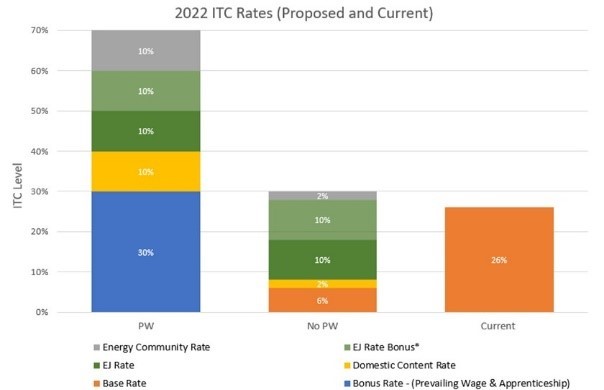
Under the BBB, the “base” ITC available to any qualifying solar project would revert to 6 percent, rising to 30 percent for projects that meet prevailing wage and apprenticeship requirements. Wage and apprenticeship requirements would apply during construction as well as for labor on repairs or alterations during the five-year ITC recapture period, unless demonstrably unavailable. As shown in the chart below, paying prevailing wages opens up much higher incentive rates.
As currently written, bonuses would be also available for sufficient use of domestic content, supporting environmental justice communities, and for facilities in qualifying “energy communities” where a coal mine or a coal-fired electric generating unit has been shut down—or will be.
Finally, two important caveats: Direct payment of the ITC is proposed for projects beginning construction after 2023 if domestic content requirements are satisfied—potentially a significant incentive for projects that struggle with traditional financing options, such as municipal utilities. Also, projects smaller than 1 MW net output would be exempt from the wage and apprenticeship requirements for the full proposed ITC.
What Already Passed?
Lost in the focus on the BBB drama are the truly transformative investments in the Infrastructure Investment and Jobs Act (IIJA) signed by President Biden on November 15, 2021, including a number of significant energy-related items. Notably to our industry, the IIJA provides significant funding and additional regulatory authority to increase electrification across transportation and building sectors and to build the regional transmission network necessary to power this shift with clean electricity.
Several provisions aim to shore up the aging electrical grid for increased electrification demand even as it is increasingly threatened by modern cybersecurity and climate change-induced extreme weather threats. These include grants to improve resiliency for weather disasters, improve grid resilience, smart grid, and for resilience and environmental protection improvements in rural areas. As much as $2.5 billion in loans are now available for the Department of Energy to support construction of nonfederal electric transmission lines and participate in the design, operation, and ownership of projects, which could alleviate some “first mover” intertia to getting new lines started. The law also requires electric utilities to promote use of demand-response and demand flexibility practices to reduce consumption of grid electricity during periods of unusually high demand, offering a significant incentive to developers who can pair solar and storage to shift solar “consumption” to match.
The new law also contains several elements designed to transform the transportation sector. The measure allocates $6.42 billion for a new program to reduce transportation-related carbon emissions, with eligible projects including truck stop electrification systems, congestion management technologies, and intelligent transportation system capital improvements. The law also offers $5 billion over five years to replace school buses with electric or zero-emission buses and $250 million for electric or low-emission ferries, bringing the benefits of clean transportation to some of the most vulnerable Americans.
The law also offers funding to other low-emission vehicles, electric vehicle charging stations, and alternative fuel infrastructure, with some funding prioritized for rural areas, low- and moderate-income neighborhoods, and communities with less access to private parking.
One final provision requires that any projects funded under the law’s energy provisions must pay prevailing wage, a requirement that we expect to continue to be in play for other publicly-supported projects under the Biden administration and increasingly at the state level, such as Illinois’s recent landmark Clean Energy Jobs Act.
How Do We Get There from Here?
As we enter 2022, the solar industry is watching intently as negotiations continue to convince Senator Manchin to make these historic and crucial investments in 21st century social, economic, and energy infrastructure. If BBB succeeds, the U.S. will be poised for unprecedented – and unprecedentedly equitable – growth in clean energy and domestic manufacturing, setting up decades of increasingly sustainable growth and international competitiveness.
Mexican Energy Reform Update: Solar Industry Awaits Answers
Policy |
By The Sol Systems Team
Building off of our previous summary, of President Andrés Manuel López Obrador's (AMLO) recent Mexican energy market reforms.
As a reminder, the reforms were proposed as AMLO’s most recent attempt to reassert control over the Mexican energy landscape – a move highly criticized across the world. As a result of this criticism and opposition to the proposed reform, AMLO’s proposal is on hold for now awaiting potential governmental action and public debate.
This week, public debate began in Mexico’s Chamber of Deputies (analogous to the U.S. House of Representatives), centered on the proposed changes to the Mexican constitution that could significantly reduce competition within the Mexican energy sector. The proposed reforms would put $22 billion in clean energy investments at risk. AMLO’s National Regeneration Movement (MORENA) is pushing the debate in what we can only gather is a hope to attempt passage of the package before the end of the current legislative session in April 2022. To pass, the package will require a two-thirds majority vote in the Chamber of Deputies, Senate, and at least 17 local congresses. Adding to the political volatility of the situation, AMLO announced that he also plans to hold a recall vote on his term in March 2022 to solidify his power and bolster his mandate to take action on the proposed reforms. Officials in MORENA believe that winning that referendum will lend legitimacy to efforts aimed at securing constitutional change.
What seems clear is that the ALMO’s primary focus remains on fossil fuel generation as the backbone of Mexican economic development at the expense of renewable energy. This reality could set in motion one of the largest international hurdles faced by renewable energy developers and large energy buyers in 2022.
Reform Consequences & Pushback
The delay was driven in-part by concerns raised by many stakeholders that ALMO’s proposed reforms are likely to violate international agreements, harm domestic economic development, reduce investor confidence, and could lead to dirtier and more expensive electricity. A recent NREL draft study predicted that the reforms would increase carbon emissions between 26 and 65 percent, raise electricity generation costs between 31.2 percent to 52.5 percent, and also increase the probability of power outages by 8 percent to 35 percent. The results of the NREL study in all three scenarios offer reason for caution.
In November, together with Cecilia Patrón, the Secretary General of the Partido Acción Nacional (PAN), the opposition party, stood firm against the reforms, stating that PAN is “opposed to the electricity reforms as they are currently drafted and Mexican families know that, because it would cause a price spike for electricity bills by increasing state control.” In the private sector, Pablo Zárate of FTI Consulting said that, “the reform – which AMLO needs opposition lawmakers to approve – also puts supply chains at risk, as companies may not be able to decarbonize their operations in Mexico to meet international commitments.” In response to a question on the politics at play, Zárate said“There are [political] actors seeking to negotiate, changing a comma or something in the margins, but this is distracting from the main considerations and implications of the reform.”
In the U.S., lawmakers in both parties have urged the Biden Administration to oppose the proposed reforms. Earlier this month, Senator Robert Menendez, Chair of the Senate Foreign Relations Committee, and three other Democratic Senators authored a letter urging Secretary of State Blinken and Secretary of Energy Granholm to oppose the reforms. The Senators not only objected to the climate implications, but argued portions of the proposal would contradict portions of the United States-Mexico-Canada Agreement (USMCA) designed to reduce national security concerns around critical mineral scarcity as well as threaten “$44 billion in private investment.” In the fall, a bipartisan group of Texas Senators and Representatives sent a letter decrying “recent actions taken by the Mexican administration to favor state owned enterprises (SOEs) and push out American investment,” highlighting that the proposed reforms for violating the USMCA and called on the White House and U.S. Ambassador to Mexico Ken Salazar to take action.
Outside of the United States, the Canadian Ambassador to Mexico, Graeme C. Clark wrote a letter to the head of Mexico’s Ministry of Energy (SENER) stating that the policy “puts at risk the operation and continuity of Canadian companies’ renewable energy projects in Mexico.”
Corporate Impact
These proposed energy reforms have unnerved foreign investors and large corporates operating in Mexico. Sarah Birke, The Economist’s Bureau Chief for Mexico, believes that the reforms will not only lead to “dirtier and more expensive power,” but that it would “damage investor confidence beyond the energy sector.” This is in part due to the damage this would do to many multinational businesses’ ESG goals. One such business is General Motors, whose Mexico Chief announced the American automaker would halt all investments in Mexico unless there were laws that promote renewable energy, threatening to claw back their announced investments of over $1 billion in electric vehicle production in Mexico beginning in 2023. At the same time, Fitch Ratings recently announced, “the energy initiative proposed by Mexico’s President López Obrador to amend the constitution would result in negative rating actions to private power projects were it to become law.” It is clear the proposed energy reforms have unnerved foreign investors and large corporates operating in Mexico, and could alter business’ ability to procure clean and competitively priced electricity.
As detailed more thoroughly in Sol’s previous article on the Mexican energy market, there is tremendous opportunity for growth in the Mexican renewable energy . While at this point, new utility-scale solar and wind projects are at a standstill, the distributed generation market continues to grow given robust customer demand and a strong domestic demand for solar.
Next Steps
As public debate on the reforms begins, key issues to follow include:
The market structure created by the 2013 Energy Reform
The State’s role in the power sector
The goals of the 2013 reform and the results
The constitutionality of the 2021 reform
The environment and energy transition.
With the debate in full swing, U.S. Secretary of Energy, Jennifer Granholm is in Mexico meeting with her counterpart, Mexican Energy Minister Rocio Nahle on potential solutions. AMLO has publicly stated that he will meet with Secretary Granholm and, “will provide information on why we need the proposed electric power reform.” Secretary Granholm issued a statement ahead of the talks saying she sees a “great opportunity” to work “towards decarbonization as a North American block.”.
As of today, it appears robust stakeholder pushback has succeeded in preventing the quick passage of ALMO’s energy reforms. However, we will be closely monitoring developments to ensure any reforms promote, rather than hinder, decarbonization and the buildout of renewable energy.