Women in Power: The Team Behind Nebraska’s Largest Solar Project
Company Culture |
By The Sol Systems Team
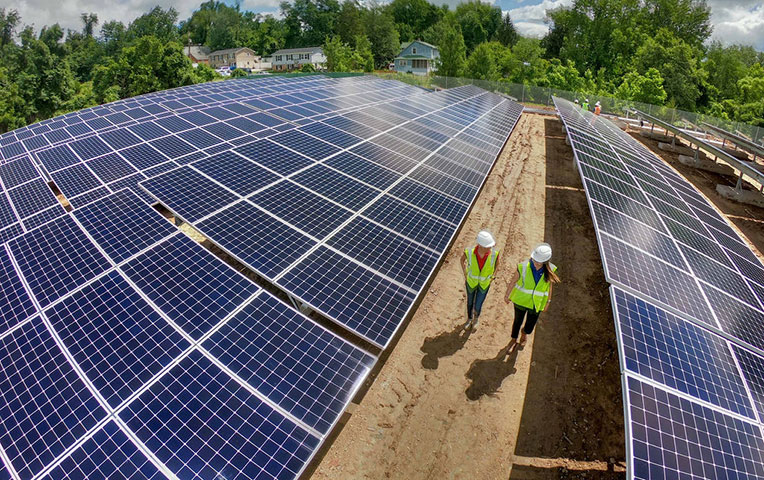
The solar industry is beginning to take steps to diversify and create new leadership and professional development pathways for women. At Sol Systems, we are completing our first project led by an all-woman development team. It is also Nebraska’s largest solar project and Nebraska Public Power District’s (NPPD) first battery storage project.
The project is an 8.5MW community solar project with 1MW battery storage in the City of Norfolk and was developed by a partnership that includes Sol Systems, GenPro, and Menser Development. Anna Noucas, Director of Origination, led the competitive RFP process submission and contract negotiations after the project was awarded. Anna’s initial Norfolk team consisted of Jill Rathke - Business Development Associate, Lauren Aycock - Project Engineer, and Erin Hickok - Senior Investment Analyst.
As the project moved into the development phase, Bridget Callahan, Project Development Manager, led the coordination of site studies and the project’s interconnection process with NPPD to ensure a smooth financing and construction process. From there, Meg Pieper, the Pre-Construction Manager, helped set construction timelines and worked to ensure project goals and needs were communicated and agreed-on by the project partners to lead the way to commercial operation, anticipated to be achieved in the spring of 2022.
Not only is this project going to be NPPD’s first solar-plus-storage project, but it is also paired with positive community and environmental impact. The project is part of NPPD’s SunWise program, a community solar initiative where customers who sign up to obtain a share will receive an electricity bill credit. The credit allows customers to benefit from solar without the upfront cost of building a solar system on their property.
In addition, the project incorporates an on-site pollinator habitat to support the local ecosystem and local pollinator populations, like bees. The inclusion and design of the pollinator habitat was completed by performance engineer Juliana Isaac. Once the project is operational, students in the Electrical Construction and Control Program at Northeast Community College, Norfolk’s local community college, will work alongside project operators and partners to gain onsite and practical solar experience. As a part of the project, the collective will provide three scholarships to students participating in the internship program, an initiative organized by Sol’s Marketing Coordinator, Claire Siwulec.
The women that designed, developed, and built the Norfolk project took charge during the COVID-19 pandemic and created a highly efficient, effective, and flexible team. The Norfolk project leaders exemplify the added value of female leadership within the industry. With women comprising only 30% of the solar workforce, there is still so much work to be done, but we hope the story of Norfolk can inspire companies to act to further the progress being created today.
Mexico’s Energy Reform: Retreating from Private Energy Markets
Policy |
By The Sol Systems Team
Mexican lawmakers are close to dismantling the national renewable energy market by acting to pass a constitutional reform proposal that would fundamentally change the Mexican national power sector leaving renewable energy buyers and developers with nowhere to turn. The proposal would devastate the energy market in the eleventh largest economy in the world.
Despite increasing corporate and consumer demand for new Mexican renewable energy, the current administration is pushing hard to pass the constitutional proposal. In essence, the proposal would renationalize the Mexican power industry and set Mexico on a backward slope, potentially erasing decades of progress in its journey to clean energy.
Current Mexico Market
In 2014, Mexican energy reform policies, while not perfect, opened the door for private energy firms to participate in the power sector. It created a wholesale market, independent system operator (ISO), and created one of the most competitive global solar markets – largely driven by corporate and customer demand.
Yet, after the election of President Andrés Manuel López (AMLO), the 2014 energy reform policies have been re-branded as a threat to the state-run electricity utility - Comisión Federal de Electricidad (CFE). It is becoming increasingly clear that AMLO is prioritizing state-owned enterprises and their legacy fossil fuel supply over a competitive Mexican energy economy. A position strongly supported and advocated for on behalf of Mexican fossil fuel monopoly and utility giants, Pemex and CFE.
Energy dominance is part of AMLO’s “Fourth Transformation” (4T) plan focused on returning economic power to the state, and as some experts have observed “change [or threaten] the very nature of Mexican identity.”[1] As a result, anti-renewable actions continue to mount, for example Executive Actions from May 2020 solidifies AMLO’s position. Shortly after AMLO was elected, the renewable energy auctions were cancelled, and it became increasingly clear that obtaining the national level permit for new renewable energy projects would be political in nature and increasingly difficult, often not possible.
Yet, one positive area of growth in Mexico has been the Generación Distribuida (DG) segment of the market – where installations less than 500 kW could receive accelerated net metering and interconnection approval. There is very strong customer demand for DG resources given both increased corporate sustainability targets and the growing concerns over rising national electricity rates.
Nevertheless, AMLO took executive action that limited large-scale solar development in favor of state-run fossil fuel entities. Yet, the Mexican Judicial branch has consistently denied his attempts to make unilateral change calling them unconstitutional. Some view the Mexican legal system as the key source of hope for the renewable energy industry during AMLO’s 6-year term limited presidential term. This hope was somewhat bolstered when during the Mexican mid-term elections AMLO’s political party - Movimiento Regeneración Nacional (MORENA) - lost several seats, although MORENA still performed well at the state level.
The New Energy Reform
The AMLO administration proposed the current Energy Reform at the beginning of October 2021, making an unprecedented attempt to renationalize the power industry, likely crippling the country’s clean energy transition and economic growth for years to come. This is evidenced by administration’s plans to table discussions on decommissioning fuel oil burning power plants, and the intention double-down on the use of PEMEX oil for power generation. This is coming from information in the energy ministry’s 2020-2024 development plan[2]. Similarly, Mexico’s increased focus on coal to generate electricity and AMLO’s acknowledged “fascination with fossil fuels” leave little doubt as to the goals and consequences of the proposed changes.
This proposed new energy reform would impose restrictions on private participation that are even more stringent than the state of the Mexican power sector prior to the 2014 Energy Reform. The proposal would make it illegal for private companies to directly procure power or self-supply energy.[3] The actions would make Mexico’s generation mix both dirtier and less reliable, likely leading to more rolling blackouts and brownouts already causing issues as energy supply growth stalls and electricity prices continue to increase.
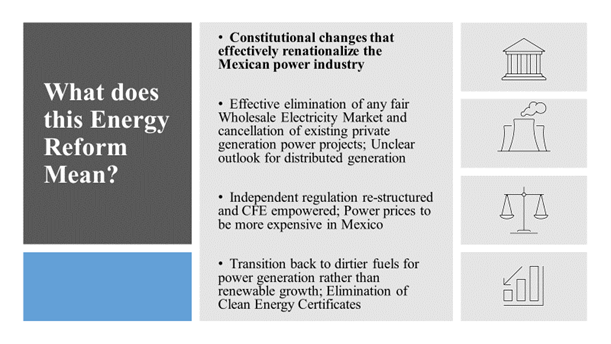
Deeper Dive on What the New Energy Reform means?
Source: Data from Consejo Coordinador Empresarial
The new energy reform targets articles 25, 27, and 28 of the Mexican constitution with the goal of reinstating state monopoly in the electricity sector by substantially changing these sections. The reforms would re-vertically integrate the national utility CFE, folding in the CRE (the energy regulatory commission) and CNH (oil regulator) into SENER (the Cabinet Department for energy), and folding CENACE (the independent system operator) into CFE. Under the new reforms, the Wholesale Electricity Market (MEM) would be effectively eliminated as CFE would oversee dispatch, determine transmission /distribution tariffs, and all pending and existing permits for large scale generation would be cancelled along with agreements made by the public sector to purchase electricity.[4] The natural concern is that the new energy reform would remove most all independent regulatory checks and any semblance of a fair marketplace.
Moving forward, CFE would be constitutionality entitled to always generate at least 54 percent of Mexico’s electricity– theoretically leaving up to 46 percent for private generation, but there is no clear way or mechanism for private generation to sell electricity, and it is hard to imagine how investors and developers will have confidence to invest in new renewable projects given this uncertainty and CFE’s discretionary power over any project.
The proposal also ends the clean energy certificates (CELs) program – the Mexican equivalent of renewable energy credits (RECs) – a further blow to any type of market structure or incentive that would support Mexico’s renewable energy targets.
Generación Distribuida (DG)
It is still unclear how distributed generation (DG) would be affected by this proposal. The text o the energy reform does not explicitly target DG, but it does propose cancelling all private generation contracts. Given the Administration’s primary focus on eliminating the larger self-supply private generation contracts (as opposed to rooftop distributed generation) combined with previous support from CFE for DG, it could be interpreted to mean that 500 kW and smaller systems will not be substantially impacted. However, the language canceling private generation contracts potentially creates uncertainty around DG too - which will put many DG investments in limbo and make it more difficult to confidently develop DG projects. Even if DG is initially unaffected, significant growth could lead to future action from the administration.
Rooftop Solar in Mexico eliminates approximately 1.3M tonnes of CO2 annually according to SENER[5] and has the capacity to increase given strong customer demand and a well-established industry. This too is threatened by this Energy Reform.
Mexican Legislative Outlook
It is hard to understate how drastic the new energy reform proposes are and how many projects, companies, and individuals the reforms would negatively impact. While on its face, the legislation lacks the two-thirds majority support it needs to pass, AMLO has increased pressure on the Partido Revolucionario Institucional (PRI) party, the party that first nationalized the oil and gas industry, in an attempt to garner enough votes.[6] According to people close to Mexican political leaders, there is an increasing sense and concern that some version of the new reform will likely pass.
What This Means
We expect a vote will happen before December. If any version of the reform passes, it seems realistic to expect that:
These actions violate the USMCA and will likely lead to reprisals not only from private firms, but from the US and Canadian governments as well.[7]
This move would put at least $45 Billion USD of projects in jeopardy and may be considered expropriation of these projects under international law.[8]
Mexico has set targets of reducing green-house gas emissions by 36% by 2030 through the Paris Climate Agreement. This energy reform likely eliminates any realistic scenario of achieving this given Administration prioritization to date.
For corporations, the dirtier and more expensive power comes with a third strike-it comes in clear contravention to their COP26 Goals.
This is projected to be devastating for the Mexican economy as seen in a study conducted by the Consejo Coordinador Empresarial, the renewable energy industry has the potential to increase the Mexican GDP by $748 million USD by 2024, generate nearly 288,000 direct, long-lasting jobs, mitigate 55 Mt of CO2 equivalents, and generate massive savings for Mexican businesses and consumers.[10]
Moving Forward
If passed, the new energy reform proposal will negatively impact Mexico, international climate, clean energy, trade, and corporate interests for the US and US actors as well. The reforms will likely trigger many renewable energy firms to exit the Mexican power market and would hamper the ability for corporations and investors to meet clean energy and sustainability goals in Mexico. Renewable energy is a global growth engine that can fuel economic and community recovery and growth.
Robots Roaming Around Solar Projects? Sol Systems’ Newest Tech Addition
Sustainability |
By The Sol Systems Team
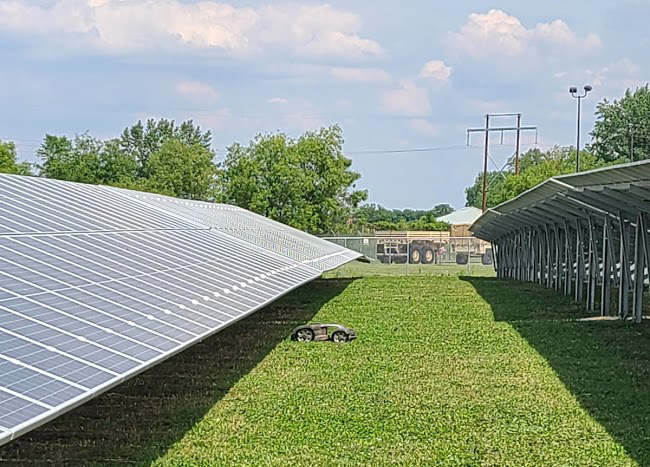
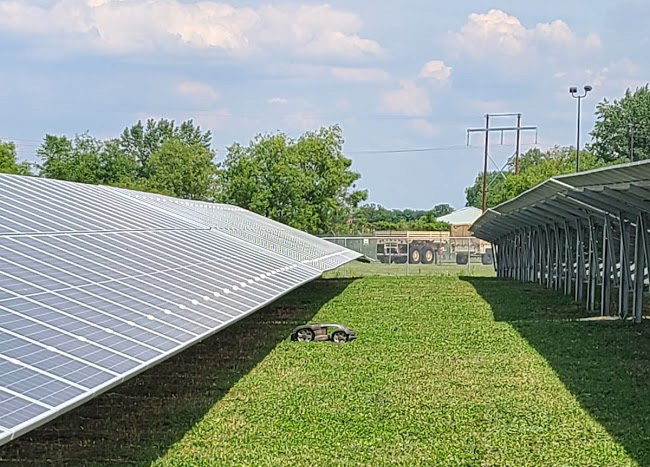
The robots are coming...to our solar sites! This spring, Sol Systems installed robotic mowers at its 1 MWac project in Rock Falls, Illinois to assist with vegetation management.
For Rock Falls, Sol Systems collaborated with the Langton Group, the Midwest arm of Automated Outdoor Solutions, to deploy robotic mowing solution at the site. Each of the five robotic mowers managing the site runs up to ten hours a day, mowing its section of the six-acre project. The mowers are self-sufficient and can dock in their stations to charge as needed. The mowers’ constant maintenance means that site vegetation is always under 6 inches in height.
As is common with solar projects, we must properly manage onsite vegetation (a fancy way of saying mow the grass) in compliance with the City. Sol regularly reviews different vegetation management options for our projects, which, in addition to traditional grass mowing, now include recent industry innovations such as native habitat, sheep grazing, and robotic mowers.
Ultimately the decision to proceed with robots came down to a combination of sustainability, economics, and a desire to better understand how robots would perform in the field. Although the robotic mowers are not 100% carbon neutral, they were the most effective and most sustainable solution to properly manage the project. We’re always excited to incorporate a new strategy to our vegetation management portfolio, which includes a growing number of pollinator habitats and now, robots.
About Rock Falls
Sol Systems installed the Rock Falls project in late 2020 with the Illinois Municipal Electric Agency (IMEA). Through a 20-year power purchase agreement, Sol Systems developed the project with zero upfront costs and helps IMEA place solar on the grid while diversifying its energy supply. This 1 MWac ground mount project spans over 6 acres on the city’s land and produces approximately 1,780,200 kilowatt hours each year, providing enough power to serve 170 Rock Falls residents. This project helps IMEA offset 850 tons of carbon each year.
About Sol Systems
Sol Systems is a leading national solar energy firm with an established reputation for integrity and reliability across its development, infrastructure, and environmental commodity businesses. To date, Sol has developed and/or financed over 1 GW of solar projects valued at more than $1 billion for Fortune 100 companies, municipalities, counties, utilities, universities, and schools. The company also actively shapes and trades in environmental commodity and electricity markets throughout the United States. The company was founded in 2008, is based in Washington, D.C., and is led by its founder. Sol Systems works with its team, partners, and clients to create a more sustainable future we can all believe in. For more information, visit https://www.solsystems.com/
To pay homage to our dedicated customer service team at Sol Systems, we launched our Service Spotlight Series! This interview series provides the opportunity for our customers and partners to get to know their customer service representatives and learn about what goes into serving our 16,000 customers each day. Our series continues with Chaz Moore, a SREC Customer Operations Analyst at Sol Systems.
Chaz Moore is a SREC Customer Operations Analyst on the SREC team.
1. What sparked your interest in solar energy?
My mom lives in California and has a small solar system on her house. When she bought it from the previous owner, this was my detailed introduction to solar energy. I learned about the ins and outs of residential solar energy and how it can save customers money. Through this, I decided to correlate my knowledge and interest with solar energy into finding different solutions for others to save money, which led to my current role at Sol Systems.
2. How have your previous roles prepared you to transition to your current role on the SREC team?
My previous roles within bank operations helped me focus on the quality of work and ability to use external and internal resources to provide great service to customers. That position gave me the ability to multitask and work on a multitude of projects to be successful and efficient in my everyday work.
3. Why do you like working with SRECs specifically?
I’ve always enjoyed dealing with finance and monetary funds. I enjoy the relationship between the trading aspects of SRECS and the issuance of payments to customers. That’s what makes the job feel fulfilling.
4. What’s your favorite part of working on a customer service team?
I enjoy learning about different variables at one time and learning more about the diversity of customer service in relation to a different type of question or project. This allows me to discover more about the discipline and overall scope of my work at Sol Systems.
5. Outside of Sol, what do you like to do for fun?
When I’m not at work, I thoroughly enjoy exercising at the gym, hanging with my friends, or discovering the latest Sci-Fi TV show.
Isla Kennedy is a SREC Customer Operations Analyst on the SREC team.
To pay homage to our dedicated customer service team at Sol Systems, we are launching our Service Spotlight Series! This interview series will provide the opportunity for our customers and partners to get to know their customer service representatives and learn about what goes into serving our 16,000 customers each day. Our series continues with Isla Kennedy, an SREC Customer Operations Analyst at Sol Systems.
1.What brought you to Sol Systems?
I completed my Master’s in Public Administration (MPA) in Energy, Technology, and Climate Policy from University College London (UCL), which focused on the intersection of engineering and technical policy solutions around clean energy. This deepened my interest in energy and decarbonization and technical solutions related to climate policy.
My passion for clean energy policy inspired me to become a member of the Clean Energy Leadership Institute (CELI). I learned about Sol Systems through CELI’s emPOWER20 conference and immediately gravitated towards the comprehensive work that was being done in renewables and the inspiring people who are a part of it who seemed to identify so strongly with their work and concrete impact it has for the future of the planet.
2. What sparked your interest in renewable energy?
Through my degrees and previous experience, I knew that I wanted to do work that intersects with my personal convictions around the environment and find the best solutions to decarbonize and electrify everything as much as possible to dramatically lower emissions.
3. Why do you like working in SRECs specifically?
I am super passionate about clean energy policy and the potential it has to shape meaningful change around mitigating the climate crisis. Because SRECs are directly affected by policy and renewable portfolio standards (RPS) in each state market, figuring out how the emphasis of tangible action creates progress makes my job feel very fulfilling.
4. What’s your favorite part of working on a customer service team?
I enjoy being able to work directly with customers and evaluate different situations across the team’s platforms to find the right answer. It gives me a sense pride and initiative knowing that I’m helping someone through the work I am doing by actively supporting incentives to expand solar adoption. I also work with a great and supportive team that is always looking to collaborate.
5. Outside of Sol Systems, what do you like to do for fun?
I love traveling and exploring new places through culture and food. I also love hiking and finding scenic views at great elevations, biking along trails, rock climbing, gardening, and photography. I have figure skated ever since I was 4 years old, and surf whenever I get a chance to visit the ocean.
Breaking the (Photovoltaic) Glass Ceiling – Celebrating Women’s History Month at Sol Systems
Company Culture |
By The Sol Systems Team
March of every year is dedicated to Women’s History Month, where women are celebrated for their contributions to society and how their actions have changed the world. The observance of the month was established after a weeklong celebration established by Congress in 1986. And now as we honor Women’s History Month, it is important to note the incredible contributions of so many different women that come from a multitude of backgrounds, each shaping the world as we know it today.
Sol Systems is committed to creating pathways for more women and diverse leaders and working to drive inclusion on an industry-wide level. Although women only make up about 26% of the solar industry, those 26% are breaking the mold for what it means to be a leader in the renewables space and opening doors for younger generations to pursue even bigger dreams. At Sol, our commitment does not stop after our monthlong celebration of Women’s History Month. We are committed to supporting courageous and leading women both internal and external, brake even more glass ceilings, and open new and rewarding renewable energy opportunities to every woman.
Through our Empowering Women series on LinkedIn, we interviewed the women working within Sol Systems about what makes them feel empowered and solicited advice that they would give to someone looking to pursue a similar career path. It was particularly insightful to learn different facts about each person that drove their dedication and commitment to renewable energy and life in general. To see some of our features, check out our LinkedIn page.
Our celebration even included a women’s history trivia night that incorporated groundbreaking facts about women leaders. We played against one another on smaller teams and included questions about women in science and technology, sports, politics, and music. Did you know that in 1988, Patricia Bath became the first African-American woman to receive a medical patent for laser cataract surgery? We discussed the importance of these groundbreaking moments in each of the categories and how much of an impact these figures have made on their industry and many times individually.
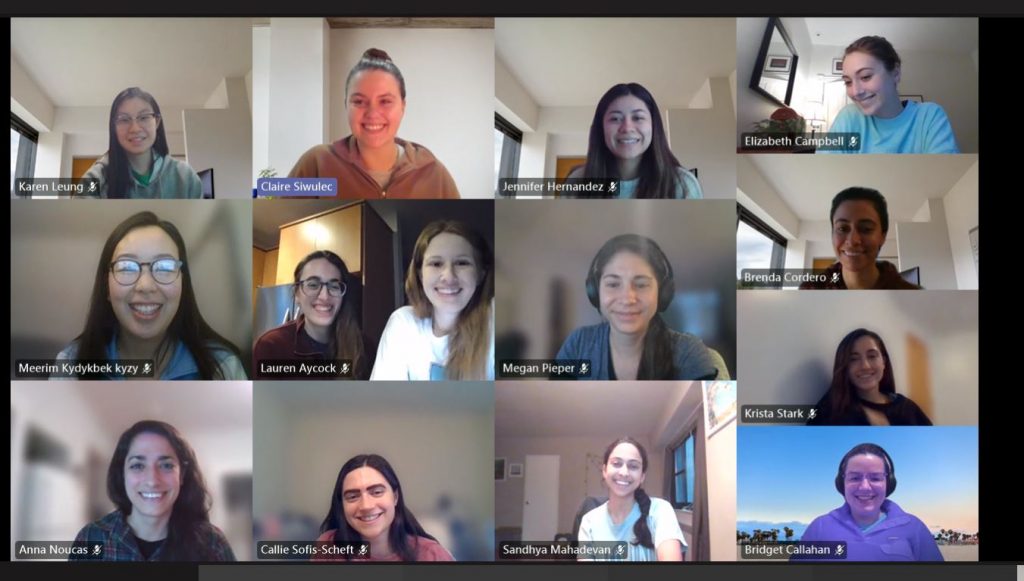
Finally, the women working at Sol came together for virtual happy hour, a tradition where the women of our organization get together to learn more about one another and to discuss life and career. Although our happy hours are usually in person, the same special moments were felt with gratitude.
The Women of Sol Systems during our virtual happy hour.
Women’s History Month may only be one month a year, but we’re making it a priority to celebrate the women of Sol and the female leaders in the solar industry 365 days a year. We hope to continuously inspire all women to purse their dream career, whether that be in solar or any other industry.