The team at Sol is heart-broken by the recent murders of George Floyd, Breonna Taylor, and Ahmaud Arbery. While it should not take murder to elicit meaningful, lasting change, we are embracing the opportunity to listen, learn, and grow, both as individuals and as a team. We stand with those that fight against injustice towards the black community not just because it is convenient, but because it is necessary for the rest of our lives and for future generations.
We
know for a fact that good intentions must be backed by action.
Sol commits to the
following:
Organizational Assessment – We commit to listening with compassion and taking concrete steps to implement feedback. We will learn more about the ways prejudice resides in individuals, teams, and institutions. We will be candid with ourselves and look to reform the image in the mirror.
Committing to Change in the Industry – We support the work of organizations like The Solar Foundation and SEIA in the realm of diversity and inclusion. We will continue to find ways to innovate how our industry supports and celebrates the black community.
Financial Investment – We are not experts on how to solve systemic bias, but there are talented entrepreneurs and political leaders committing themselves to addressing the problem of systemic injustice and racism faced by the black community. Sol has established a minimum annual fund of $50,000 to invest in under-resourced communities and especially black communities.
Continued Growth – We built this company on a vision of bold innovation and seamless collaboration. It powers our business, our people, and our leadership in the solar energy industry. We are a company of big ideas and real results, doing work that matters. We care deeply about creating a safe environment where everyone has a voice to lead and impact. We will not let the murder of George Floyd, Breonna Taylor, Ahmaud Arbery, and countless other black people be in vain. We are committed to using our resources to ensure that we honor, protect, and celebrate all black lives.
In
this moment and in the future, black lives especially matter and demand our
compassion and attention. We will continue to strengthen our communities by
standing up against police brutality, racism, and injustice. We aren’t afraid
of the challenges that lay ahead; if we were, we wouldn’t have built this
company.
We send
our love to so many of you who are in anguish right now. While we may not know your personal pain, this pains us too.
Black lives matter. Black children matter. Black futures matter.
The Dirt on Solar as an Essential Service: What happens when your work is “essential” but the services you rely on to complete your work are not?
Renewable Energy Procurement |
By The Sol Systems Team
Solar Designated
as an Essential Service in Illinois
On March 20,
Illinois Governor JB Pritzker signed an executive order instructing his
constituents to stay at home to limit the spread of COVID-19. All businesses
deemed "non-essential" were required to suspend operations, and all
travel not considered essential was prohibited.
After consulting guidance from federal agencies including the Centers for Disease Control, Department of Homeland Security, and Cybersecurity and Infrastructure Security Agency (CISA), the Solar Energy Industries Association (SEIA) determined that solar energy construction was considered an essential business and allowed to proceed.
“Workers
who maintain, ensure, or restore, or are involved in the development,
transportation, fuel procurement, expansion, or operation of the generation,
transmission, and distribution of electric power, including call centers,
utility workers, reliability engineers and fleet maintenance technicians.”
SEIA issued specific recommendations for installers, EPC’s, and O&M providers for avoiding viral transmission between contractors, potential customers, and partners. One example of these precautions is to ensure crews have the proper PPE and sanitizing equipment in their work vehicles. Additionally, solar energy site hosts and landowners would have to approve of any work conducted on their property during this period.
However, despite this guidance, many firms are open to interpret these orders as they see best fit, and even the Illinois Solar Energy Association (ISEA) has stated on its website, “each company needs to make its own determination if it considers itself an essential business under the state executive order.”
Can You
Dig It?
Since Gov. Pritzker’s executive order was issued, and while it might not be quite “business as usual,” Sol Systems has broken ground on several Illinois solar projects, moving forward to build project components such as fences and access roads. And, while the guidance does indicate that solar is an essential business, not all contractors have been able to complete the necessary tasks for Sol to continue its development plans to complete solar projects in Illinois.
For example, in the earlier stages of solar project development, two key goals are to
Uncover information about the site, and
Use that information to mitigate risk
What this looks like in practice is a series of site assessments that happen months or even years before solar energy construction can begin in earnest (and that’s if you are lucky). These site assessments are typically quite specific. They are completed by firms that offer specialized services, like environmental assessments, land surveys and records, and geotechnical assessments, which determine how to best design the solar array given the soil and rock on site. The assessments are typically a gating item to securing financing, locking in engineering plans, and starting construction. They are also, in theory, pieces of the project development puzzle that can reasonably continue during COVID (unlike, for example, a face-to-face customer meeting or an in-person zoning board meeting). Each firm is different and must assess their unique risk based on equipment used, operating procedures, distance travel, and crew size (to name a few factors). This is compounded by eagerness by employees to get back to work, and pressure by developers to push these items along by any firm that is able to safely complete on-site work.
The Plot
Thickens
To dig in
further on our Illinois sites under development, recently one project
experienced a small hiccup in which many of these specialized assessments were
completed as expected, but the full geotechnical assessment was halted.
Specifically, the contractor had implemented a company policy to stop all
on-site boring work (the type with a very large drill that shows us soil
profiles, not the type that makes you yawn) until the stay-at-home order is
lifted.
After this setback, we immediately got to work thinking of new ways to achieve our two goals of uncovering site information and using it to mitigate risk. For this project, what that meant was working with our partners to adapt to our new circumstances and constraints.
Can we dig in further
to publicly available records?
What desktop analysis
can be completed?
Does the site host or
landowner have older copies of these site assessments from prior development
that they can unearth for us?
Do our contractor
partners have any relevant local knowledge that might be used?
For this project,
the answers to these alternative paths forward was “yes.” And, while these
approaches might not be adequate to finalize a construction design or satisfy
all investor criteria, they can help push projects ahead so we don’t lose much
ground.
A Resilient
Solar Industry
As of May 6th,
Gov. Pritzker had extended the stay at home order effective until May 29th,
and had announced a five-phase plan, “Restore Illinois” for gradually reopening
the state.
So, as we continue through uncharted territory, we will continue to support our state and national solar associations as they promote solar development as an essential service, while serving as an industry resource wherever we can provide value. Sol Systems can offer legal expertise about definitions or essential services, offer more detailed information about how to complete site work in all stages of the project pipeline safely, and continue to share ideas on creative solutions to mitigate project resources.
ABOUT SOL SYSTEMS
Sol Systems is a leading national solar energy firm with an established reputation for integrity and reliability across its development, infrastructure and environmental commodity businesses.To date, Sol has developed and/or financed over 850 MW of solar projects valued at more than $1 billion for Fortune 100 companies, municipalities, counties, utilities, universities and schools. The company also actively shapes and trades in environmental commodity and electricity markets throughout the United States. The company was founded in 2008, is based in Washington D.C, and is led by its founder. Sol Systems works with its team, partners, and clients to create a more sustainable future we can all believe in. For more information: www.solsystems.com
Uniting with Local Governments to Engage Communities During COVID-19c
Policy |
By The Sol Systems Team
While a typical news cycle may lead you to think otherwise, the executive branch is not the most impactful level of government for the average American citizen. Our daily lives are most affected by a handful of our neighbors making decisions right down the road: noise ordinances, parking regulations, and building codes. These decisions are the outcome of collaborative processes such as community surveys and neighborhood meetings.
So, when a pandemic hits, what becomes
of community engagement with these local governments? Civil servants who rely
on public input are now entering territory that can significantly distort
representation; switching to online surveys or video conferencing can
marginalize the group of senior citizens who regularly show up to council
meetings, while reminding twenty-somethings that they have a voice too (and that
no one appreciates electric scooters being dumped everywhere). The family-run
farm that supplies dairy and meat for the only grocer within 30 miles doesn’t
have Google Fiber that allows them to effortlessly dial in on Skype. Strong relationships
with local leadership are critical in keeping exurban and rural America
connected and heard.
Local governments are adapting how
they maintain transparency of their day-to-day work while observing physical
distancing guidelines. Even prior to stay-at-home orders, improving participation
in local elections, surveys, and other engagement was a feat. And, now
distancing is cultivating concerns that governments will lose connectivity with
constituents. Yes, executive orders and waivers can mitigate some issues like
in-person plan review requirements or neighborhood meetings for grant
compliance, but many small jurisdictions are already overwhelmed with
bureaucratic procedures. Drafting and completing these stop-gaps will be a huge
burden for municipal staffs with limited resources.
Working in utility-scale solar energy development, I became familiar with the small, rural counties of the United States and the challenges they face on a daily basis. Many jurisdictions have only part-time staff and employ planners that also work at neighboring towns. These communities prioritize efforts to keep their publics engaged and informed.
Public input is also a vital
component of development and construction, and the solar industry must welcome
involvement and earn trust from the citizens we respect so much. Solar developers
value the landowners that lease us their land without the guarantee that the
project will actually pencil and be built, the neighbors that tap us on the
shoulder when the subcontractors park on their lawn, and the people that show
up to public hearings about our projects to learn about what we do. It warms
our hearts to share the benefits of solar and help others navigate
misinformation. We love connecting with and learning from our neighbors.
While a lot of rural Americans do not have access to high speed internet, many do rely on their land-line telephones for communication. What if developers collaborate more closely with jurisdictions on appropriate notification ranges and work the phones to aid in collecting public input? We can help boost the capacity for government staff to stay connected with constituents about projects via telephone outreach and citizen network programs that proactively inform and invite feedback about proposals in each jurisdiction. Phone conversations have proven more effective in responsiveness compared to mailer campaigns. And, the two efforts combined offer the greatest chance for valuable, lines of communication directly to the companies proposing the projects. This approach can provide a comparable level of information sharing as public hearings while removing the obstacle of scheduling conflicts, and, of course, adhering social distancing guidelines.
It’s my dream that this challenge
can ultimately unite us across all sectors. Solar companies can only become
productive members of the communities they serve with public input and close collaboration
with local governments.
At Sol Systems, we have attended numerous local government meetings over the years to ensure our projects complement the values and goals in the communities we serve. Today, we must lead with empathy for both those directly impacted by the virus, and also for local government leaders working to keeping us all healthy, connected, and engaged as we navigate our current circumstances.
ABOUT SOL SYSTEMS
Sol Systems is a leading national solar energy firm with an established reputation for integrity and reliability across its development, infrastructure and environmental commodity businesses.To date, Sol has developed and/or financed over 850 MW of solar projects valued at more than $1 billion for Fortune 100 companies, municipalities, counties, utilities, universities and schools. The company also actively shapes and trades in environmental commodity and electricity markets throughout the United States. The company was founded in 2008, is based in Washington D.C, and is led by its founder. Sol Systems works with its team, partners, and clients to create a more sustainable future we can all believe in. For more information: www.solsystems.com
Business as Unusual: One Company’s Story of Adapt and Adopt Part 2 (of 3): Culture, Family, and Love
Company Culture |
By The Sol Systems Team
At
a time when all of us need the support of our friends and families to cope with
the impacts of COVID-19, we also find ourselves isolated. Fortunately, thanks
to 2020 technology, digital portals offer new and creative ways to keep
connected to our families, friends, and coworkers so none of us feel alone.
In
part one of our “Business as Unusual” series about how one company, Sol, is
adapting, we shared tools
and methods for being productive as we push toward continued company and
industry growth. For part two, we’d like to shift gears and share ways we are
engaging our community and connecting with each other, preserving what makes
Sol so special.
Game Night – Kate
Brandus – Director, SREC Asset Management
In late March, I had a game night with my cousins using the "Houseparty"
app. This was my first time doing a virtual game night, but it ended up being
ton of fun! Prior to the COVID crisis, Sol Systems would host game nights every
month or so, and they were always a great time and good for team building. So I
decided to bring the game I played with my cousins to my coworkers and host our
first virtual game night.
The game night ended
up being a lot of fun and provided me with an opportunity to bond with
colleagues after work that I normally wouldn't have had the opportunity to.
Intranet Channels –
Ann Sweitzer – Human Resources Director
When we transitioned
to a remote work environment in early March due to COVID-19, one question that
we wanted to address was, “How do we
maintain our culture and employee morale in a remote environment?” What
makes Sol a special place is our people and we wanted to ensure that everyone
felt connected and engaged even though we were no longer together in the
office. We got creative and implemented various virtual sessions including
coffee meetings, morning mindfulness, evening happy hours, yoga, lunch time
roundtables, book clubs, etc., to keep the team engaged.
It was important for
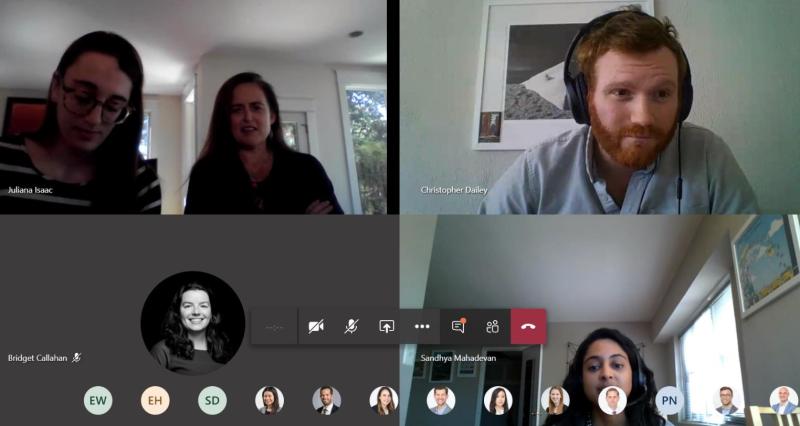
us to be inclusive of all so we also used the platform Microsoft Teams to
foster communication in a remote setting and created channels Working While Parenting, Mental Health &
Wellbeing, and other groups. Channels are built around a topic where you
can hold meetings, having conversations and share resources. We also created
the Sol Hub in SharePoint as a landing page for company events, project wins,
special life events, COVID-19 related news and general team resources.
We’re continuing to
think of ideas on how we can foster our Sol culture in a remote workforce.
During this challenging time with unprecedented change and uncertainty, it is
more important than ever that our team feels supported, engaged and connected.
Sourdough Roundtable
– Sandhya Mahadevan – Business Development Senior Associate
The
thing I miss the most about being in the office is being around people I care
about and catching up on their lives. We have an extremely caring and social
culture at the office, and something everyone can connect to is food. Before
COVID, coworkers often brought in treats to share with the office, whether they
be home-made or from travel. Now in isolation, an extra focus on cooking has
become a welcome distraction, and our team has naturally been chatting more
about our culinary creations even if we can’t physically share food with one
another.
As
someone who is extremely new to bread-baking, I had questions and knew a few
people who were seasoned bakers. I collected questions in advance and sent them
to my “panelists” in preparation for a Q&A session about sourdough that we
held over video chat. People really enjoyed it, and at the very least, I
learned some new tips for my sourdough technique. I may try to host another
roundtable in the next month, potentially on coffee. Similar to sourdough, I’m
no expert on coffee, but I’m curious, and I need something to obsess over
besides washing my hands.
Sol’s coffee culture
runs deep. At any given hour in Sol’s history, two or more people are sure to
be connecting on business, family, or just fun matters over a cup of joe. In
fact, the coffee connection is so important to our bonds that it’s incorporated
into onboarding for new team members. Whether they enjoy java or prefer another
beverage, a full line-up of coffee chats is scheduled to kick off their Sol
careers with a full cup.
Fast forward to 2020
stay at home. From day one of the company starting to work 100% remotely, we
formalized and reinforced our coffee culture to maintain our community
connections even when telecommuting.
We booked team coffee
chats, at first daily, and then 2-3 times a week via Teams video. We have
actually connected even more often and more broadly through our virtual coffee
chats. We tackle any concerns if they come up, plan out the day, meet our
teammates children, dogs, and cats, and get virtual home tours.
Turns out the Sol
coffee culture is a cornerstone of our resilience toolbox as we work together
to reduce the impacts of COVID-19 on our business and in our communities.
Business Book Club –
Mike Gibson – Chief Technology Officer
Self-improvement and professional development are very important to the members of the Sol Systems team. I myself am a fan of the aphorism "a rising tide lifts all boats" - the more we can develop our individual talents and understanding of their application to our business, the better we'll perform and the more good we can do as an organization. To help in "raising the tide," we started a Business Book Club at Sol. The club is open to all members of the Sol Systems team, regardless of position or title. Each month, the club sponsors a discussion of a business or management book and its application to our work at Sol.
Thanks to the fantastic suite of Office 365 products from Microsoft, the club hasn't skipped a beat during the shift to remote work - meetings have moved from the conference room to Microsoft Teams, and participation has remained steady. With these tools, we're able to collaborate as if nothing has changed, and continue to maintain a level of personal interaction that we otherwise might have lost.
ABOUT SOL SYSTEMS
Sol Systems is a leading national solar energy firm with an established reputation for integrity and reliability across its development, infrastructure and environmental commodity businesses.To date, Sol has developed and/or financed over 850 MW of solar projects valued at more than $1 billion for Fortune 100 companies, municipalities, counties, utilities, universities and schools. The company also actively shapes and trades in environmental commodity and electricity markets throughout the United States. The company was founded in 2008, is based in Washington D.C, and is led by its founder. Sol Systems works with its team, partners, and clients to create a more sustainable future we can all believe in. For more information: www.solsystems.com
Business as Unusual: One Company’s Story of Adapt and Adopt Part 1 (of 3): Productivity Tools that Work So We Can
Company Culture |
By The Sol Systems Team
Here we are, all of us together, arguably facing the
biggest challenge, threat, and opportunity of our lives. Emotions of disbelief,
or maybe fear and grief, are giving way to ingenuity and perseverance. As the
ground shifts under our feet, so do our priorities.
Just as many of you have shared your tips and
inspirations to push forward and stay connected, the Sol team would like to
share what we are doing to make the company, team, and ourselves individually,
even stronger.
We hope you find new ideas and resources you can use
from this three-part series of what and how Sol is adapting in real time to be
as, if not more, productive and connected as ever. Together, we will achieve
our 2020 goals, and come out on the other side even more able.
Tom Griffin, Development Engineer
“We have both business analysts and engineers using Helioscope for high level project assessment. It allows those with little to no technical background to effectively assess a project site. If the project looks like it may be worth something, it typically then gets a deeper dive from someone on the engineering team before any numbers are put in front of the customer. Because Helioscope is cloud-based, it enables real-time collaboration, sharing of designs and work products, and for other teammates, to access deliverables remotely so they can monitor the status of design efforts.”
Jill Rathke, Business Development Analyst
“When working remotely, agendas sent around in advance are particularly useful for collaboration in meetings with large numbers of attendees, especially in Microsoft Teams! The agenda allows for easier delegation, more smooth transitions (especially if attendees can send a Teams chat to stay included in discussion without interruption), and makes it easier for the meeting leader to efficiently get through all discussion topics. Also, remote work makes virtual meetings an important opportunity for social interaction. I add an agenda item at the beginning or end of a meeting for catching-up, sharing a story, bringing a pet or child to say hi, etc., because this not only provides structure to the meeting, it prioritizes the space to foster the colleague friendships that make Sol Systems such a fun place to work.”
Rob Pierno, Business Development Manager
“LinkPoint is spectacular and a huge time saver. The
Business Development team at Sol Systems uses LinkPoint to upload outgoing
emails and automatically log all incoming emails to the corresponding
Salesforce Account. It saves the team time and prevents user error from
forgetting to log important communications in our CRM.”
Rob’s quarantine highlight has been witnessing his daughter take her first steps
Sandhya Mahadevan, Business Development Senior Associate
“Our customer relationship management (CRM) tool, Salesforce, provides our sales with visibility into customer-specific information in a centralized location. We use it to track project-specific information like the customer’s annual electricity usage, price of power, and preferred contract term length. This type of information helps the team design the right type of system and contract structure for the customer. It saves me a lot of time by clearly outlining next steps on an opportunity. Rather than having to search through my emails or tap a co-worker on the shoulder, I can easily see if someone has assigned me a task in Salesforce. Salesforce is expressly designed as an online tool because sales teams are often spread out geographically to be closer to the customers they serve, so it’s working seamlessly for our team while we’re working from home. ”
Adam Polis, Performance Engineer
“I’m a big fan of the “Linkclump”
extension in Chrome. It enables the user to be able to open up to 20 tabs at
once with one click. I use it for opening all of my sites at the same time. I
also use it when going through annual reports where I have to open a ton of
pictures at the same time. I’m using it even more now that we’re all working
remotely. It’s a small tool that makes a huge difference.”
Brenda Cordero, Project Coordinator
“Our project management platform, Procore, is indispensable to our team because it gives us one area to manage nearly every aspect of the project lifecycle, including engineering drawings, submissions, punch list items, and other action items. We were able to customize this to best fit our team and project processes. This allows us to easily share information with new hires joining our team, and how to best share information with third party project managers, construction managers, and contractors. We have been using this tool with remote workers for more than two years, so it’s an integral tool for us now that our entire team is working from different locations.”
*Disclaimer: These tools are not formally endorsed by Sol Systems, nor did we earn any kind of compensation for including them here. Opinions expressed are specific to the noted team members.
ABOUT SOL SYSTEMS
Sol Systems is a leading national solar energy firm with an established reputation for integrity and reliability across its development, infrastructure and environmental commodity businesses.To date, Sol has developed and/or financed over 850 MW of solar projects valued at more than $1 billion for Fortune 100 companies, municipalities, counties, utilities, universities and schools. The company also actively shapes and trades in environmental commodity and electricity markets throughout the United States. The company was founded in 2008, is based in Washington D.C, and is led by its founder. Sol Systems works with its team, partners, and clients to create a more sustainable future we can all believe in. For more information: www.solsystems.com
New Jersey’s Legacy SREC Program Reaches a Transition Point
Policy |
By The Sol Systems Team
New Jersey plans to
close its legacy Solar Renewable Energy Credit (“SREC”) program at the end of
April. However, the closure of the program is by no means the end to solar in
New Jersey.
Per the Clean Energy Act of 2018, New Jersey is required to close the current SREC incentive program once the New Jersey Board of Public Utilities (“BPU”) determines solar electricity generation equals 5.1% of the total state electricity generation load. Last week, just over a year later, the BPU announced that it will meet the 5.1% and will move forward to close the legacy program by May 1, 2020.
Importantly, solar projects that are already in the legacy program will remain eligible under the legacy program and will continue to generate SRECs for the term of their qualification life. However, moving forward the Clean Energy Act of 2018 tasked the BPU to develop a successor solar program.
While the design and structure of the successor program is not final, the BPU has proposed and finalized a new, temporary transition incentive program. Solar projects that have submitted a complete application to the legacy SREC registration program, but are not yet operational, will be eligible for this transition program and its new Transition Renewable Energy Credits (“TREC”) which, like the legacy SREC, a TREC will be generated on a per MWh production basis. This TREC program will officially open on May 1.
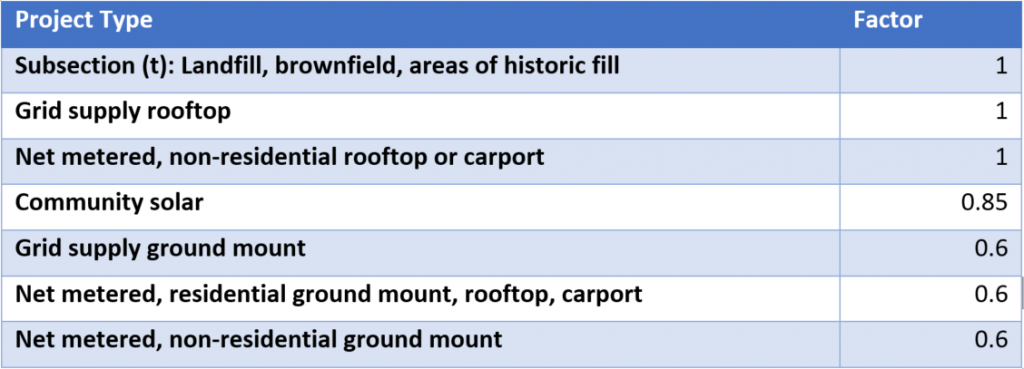
Under the new TREC program, a new solar project will be eligible for TRECs for 15 years and each TREC will have a two-year life. The TREC price is proposed at a fixed rate of $152 for the 15-year eligibility period. However, unlike the legacy program, the new price per TREC will be factored based on project type. The factors are as follows:
The incorporation of this factorization means the value of each TREC will differ based on project type. A project’s TREC value will be the base compensation rate of $152 times that project type’s factor. For a residential customer the TREC value is calculated by multiplying $152 by residential’s 0.6 factor, which yields a residential price of $91.20 per TREC for 15 years.
The intent of the new
TREC program is to ease the transition between the legacy SREC program and what
we hope will be a robust, long-term successor program.
It is essential for Sol Systems and other renewable energy companies to remain involved in the process as the BPU moves forward to design and implement the successor program. As of now, the BPU is holding discussions with stakeholders and actively requesting and accepting feedback. Solar energy is key to success of New Jersey’s competitive energy market and the continued growth of the industry is necessary to provide much needed job growth along with community economic and environmental health benefits.
ABOUT SOL SYSTEMS
Sol Systems is a leading national solar energy firm with an established reputation for integrity and reliability across its development, infrastructure and environmental commodity businesses.To date, Sol has developed and/or financed over 850 MW of solar projects valued at more than $1 billion for Fortune 100 companies, municipalities, counties, utilities, universities and schools. The company also actively shapes and trades in environmental commodity and electricity markets throughout the United States. The company was founded in 2008, is based in Washington D.C, and is led by its founder. Sol Systems works with its team, partners, and clients to create a more sustainable future we can all believe in. For more information: www.solsystems.com