


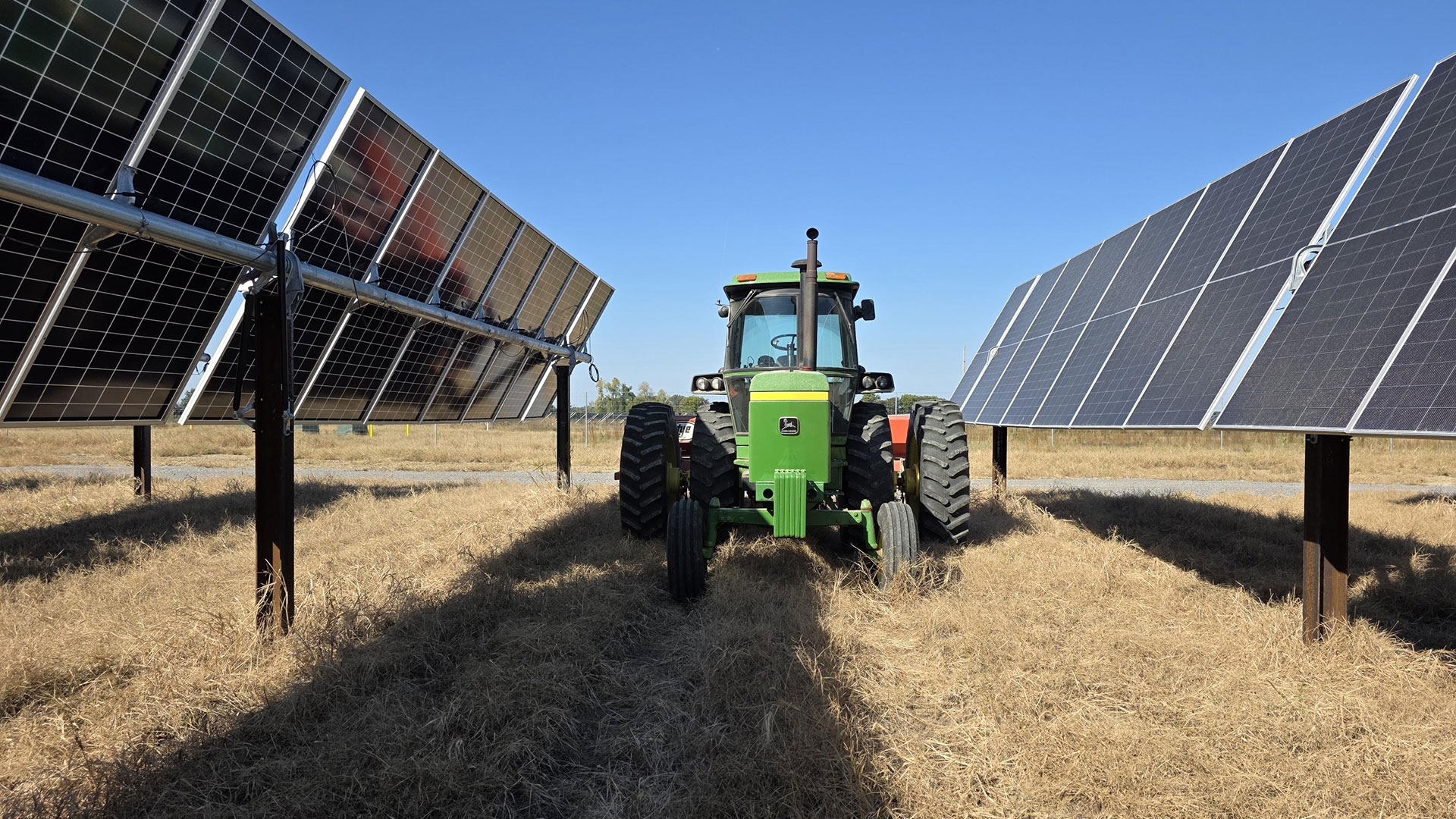
For years, the clean energy transition has been framed as a tradeoff, energy vs. land, infrastructure vs. agriculture, climate progress vs. community priorities. Sol Systems is proving that’s a false choice.
Across the country, particularly in Southern Illinois, Sol has been building a new model: agrivoltaics at scale, where solar energy and agriculture don’t compete for land, but actively strengthen one another.
A Track Record of Real Projects, Not Pilots
At the center of this work is the Eldorado Solar Project in Saline County, Illinois, a 342 MW facility and one of the largest agrivoltaics projects in the United States.
- Developed with partners including American Farmland Trust, Food Works of Southern Illinois, Nextpower, and SOLV Energy
- Integrates the farming of Kernza®, a deep-rooted perennial grain, and specialty crops, like fruits and vegetables, grown directly beneath solar panels
- Designed to improve soil health, water retention, and long-term farm viability and create economic opportunities for experienced as well as new and beginning farmers
Eldorado is a working proof point that row-crop and specialty-crop agriculture and utility-scale solar can coexist meaningfully at scale, complemented by pollinator habitats and livestock grazing. And it’s not alone.
- At Prairie Creek in Morgan County and Tilden in Randolph County, Sol has implemented sheep grazing to manage vegetation while creating new revenue streams for local farmers
- Furthermore, at Tilden in Randolph County, Illinois, Sol transformed a former coal mine into a 186 MW solar project, part of a broader portfolio of dual-use solar projects developed in partnership with local stakeholders and landowners
Together, these projects show that agrivoltaics is a flexible toolkit that adapts to crops, livestock, and land conditions.
Built Through Deep Partnerships
Sol’s emphasis on partnerships enables innovative research and development to support dual-use solar.
- American Farmland Trust is advancing research on soil health, crop productivity, and land stewardship
- The Land Institute is enabling the cultivation of regenerative crops like Kernza®
- Local farmers and landowners are ensuring projects support working lands, not displace them
- Food Works is training beginning or transitioning farmers in sustainable farming to create a pipeline of farmers focused on addressing food insecurity in their local community
- Industry partners like Nextracker and SOLV Energy are engineering systems that enable agriculture and energy to function together
These collaborations turn solar sites into living, learning test beds, generating data and models that can be replicated nationwide.
Why Agrivoltaics Works
Sol Systems’ work demonstrates three core truths about agrivoltaics:
1. It Protects and Enhances Agricultural Land
Perennial crops like Kernza reduce tilling, improve soil structure, and capture carbon, while grazing and pollinator habitats support biodiversity and long-term land productivity
2. It Strengthens Rural Economies
Projects like Eldorado deliver:
- Long-term tax revenue (tens of millions over project life)
- Committed, long-term funding for schools, food programs, and community organizations
- Local jobs, expanded career pathways, and long-term economic opportunities
- Access to locally grown food delivered to schools, hospitals, and the larger community
3. It Unlocks Siting at Scale
By making solar compatible with agriculture, agrivoltaics reduces land-use conflict, one of the biggest barriers to deploying clean energy quickly and responsibly.
From Concept to Replicable Model
For nearly a decade, Sol Systems has been advancing agrivoltaics from early-stage experimentation to utility-scale deployment.
Eldorado proves that:
- Agrivoltaics can work with row crops, not just grazing
- It can scale to hundreds of megawatts by leveraging a menu of options
- It can deliver measurable benefits for farmers, communities, and the grid
Or, as Sol’s leadership has framed it: this is about showing that solar and agriculture don’t just coexist, they thrive together.
The Bigger Picture
As energy demand grows, driven by electrification, AI, and data centers, the U.S. faces a critical question: How do we build the energy infrastructure we need without sacrificing the land and communities we depend on? Agrivoltaics is one of the most compelling answers. And Sol Systems isn’t just talking about it, we’re building it, refining it, and proving it works in real communities, on real land, at real scale, with real results.